Ancient Origins: The Rock Before the Town
Long before any of the great civilizations that would shape Sicily arrived, the massive limestone headland that dominates Cefalù's skyline was already a place of human habitation. Archaeological evidence suggests settlement on and around La Rocca from the Bronze Age, perhaps as far back as 1500 BC. The defensive advantages were obvious: a near-vertical cliff rising 270 metres from the sea, with a single negotiable approach from the east.
Near the summit of La Rocca stands one of Cefalù's most ancient secrets: the Temple of Diana, a megalithic sanctuary constructed in the 9th century BC — before the Greeks ever arrived in Sicily. Built from massive uncut limestone blocks using a technique known as opus incertum, it was dedicated to the goddess of the hunt and the moon and remained a sacred site for centuries, later repurposed as a Byzantine cistern. The ruins you can visit today are among the oldest standing structures in Sicily, and the view from beside them — the entire coastline spread below, the Cathedral rising from the medieval streets — is one of the most extraordinary in the Mediterranean world.
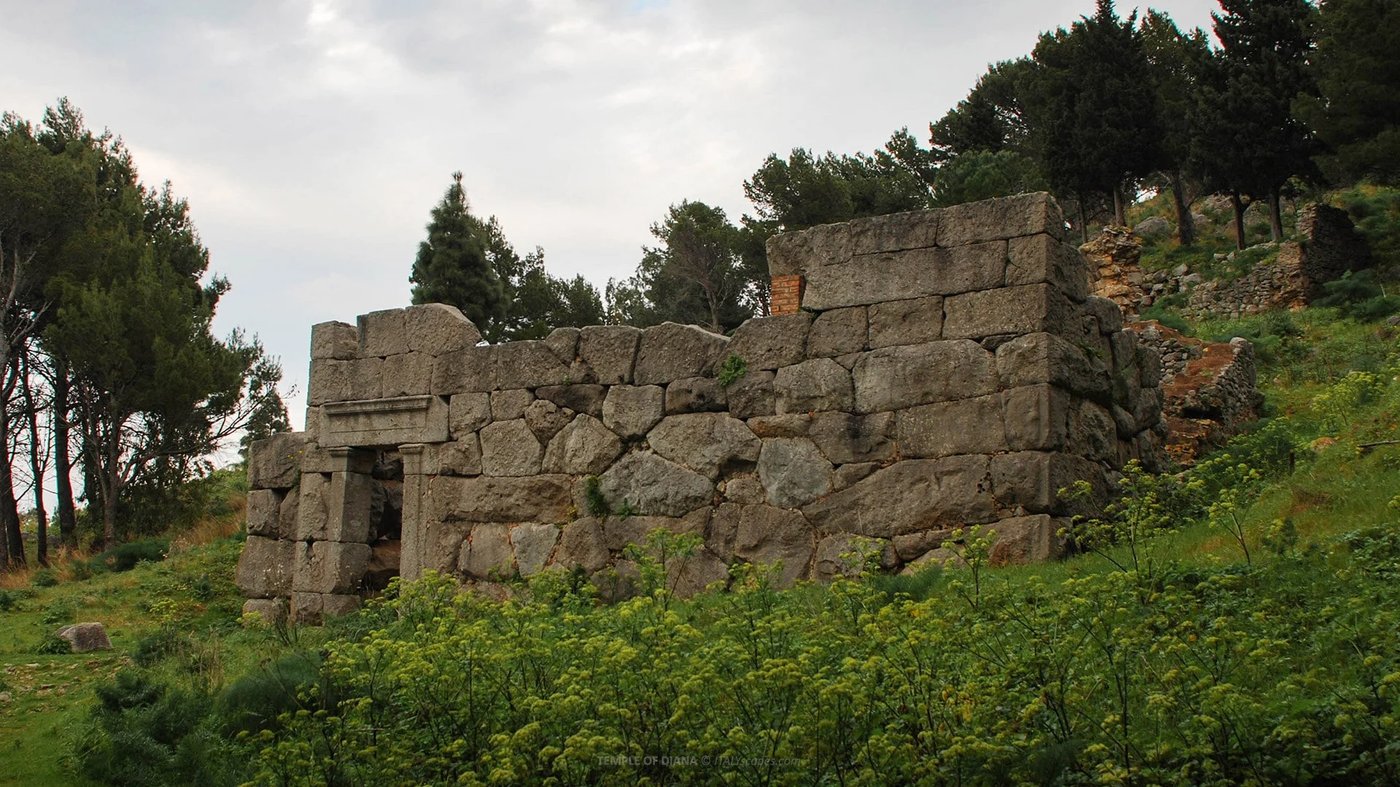
The Temple of Diana on La Rocca — built in the 9th century BC, among the oldest structures in Sicily.
When Greek colonists arrived around the 5th century BC, they named the promontory Kephaloidion — from the Greek kephalé, meaning head — a direct reference to its shape. The settlement at the foot of the rock became a minor but strategically useful Greek city. Sicily's ancient history is inseparable from the rivalry between Carthage and the Greek city-states of Syracuse and Akragas; Cefalù changed hands several times before falling to Rome in the First Punic War (264–241 BC). Under Roman rule it became a quiet provincial town with its own forum, temples, and — as always — a fishing fleet.
"The Greeks named it Kephaloidion — the Head. Over three millennia, the name became Qaflūdī under the Arabs, Cefalù under the Normans, and remains so today."
The Arab Era: A New Sicily
In 827 AD, an Aghlabid Arab force landed on Sicily's southwest coast and began a conquest that would take over a century to complete. Cefalù fell in 858 AD, becoming part of the Emirate of Sicily — one of the most culturally sophisticated polities in the medieval Mediterranean world.
The Arabs transformed Sicily. They introduced citrus, sugar cane, cotton, and mulberry, and revolutionized agriculture through advanced irrigation techniques. They brought with them mathematical, astronomical, and philosophical knowledge that Europe was only beginning to rediscover. Arabic became an official language alongside Greek and Latin. The influence on Cefalù was lasting: Arab place names echoed through the town's geography for centuries, and the street plan of the old town — dense, organic, oriented inward — bears the unmistakable character of Arab urban planning.
The Lavatoio Medievale — the medieval washhouse at the base of La Rocca — is the most direct surviving link to this era. Fed by a natural spring whose source lies deep inside the rock, the Arab-Norman washing basins were constructed in the 12th century using an engineering tradition that came directly from the Arab world. The water has flowed without interruption for nearly 900 years.
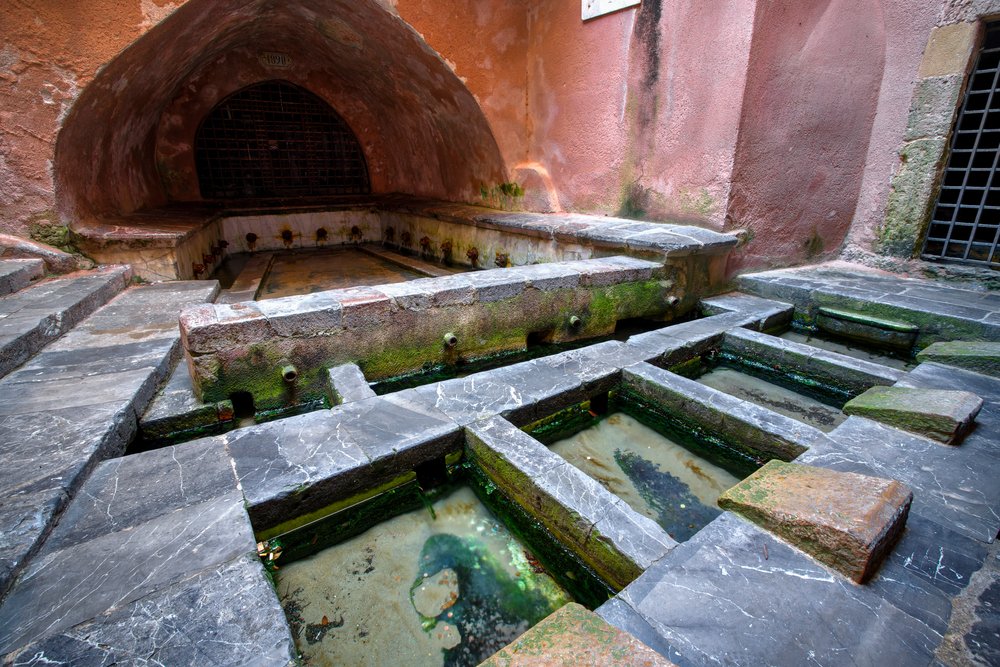
The Lavatoio Medievale — fed by a spring that has flowed without interruption for nearly 900 years.
The basins are still used today. Walk down the narrow alley beside the Cathedral and through the low arch, and you find yourself in a space utterly unchanged: stone channels, flowing water, the carved heads of lions spouting the spring into the basins below. It is one of the most quietly extraordinary places in Sicily.
The Normans: Roger II and the Cathedral
In the decades following 1061, Norman adventurers led by Roger I of Hauteville began the reconquest of Sicily. By 1072 Palermo had fallen, and by the turn of the 12th century all of Sicily was under Norman control. The Norman state that emerged was something remarkable: a multicultural kingdom where Christians, Muslims, and Jews coexisted, where Arab scholars served at court, and where a unique architectural synthesis fused three traditions into something entirely new.
It was Roger I's son, Roger II, who made Cefalù immortal. The story holds that in 1129, Roger was caught in a violent storm at sea near Cefalù. He vowed that if he survived, he would build a cathedral in the town as a votive offering. He survived. And in 1131, he founded the Cathedral.
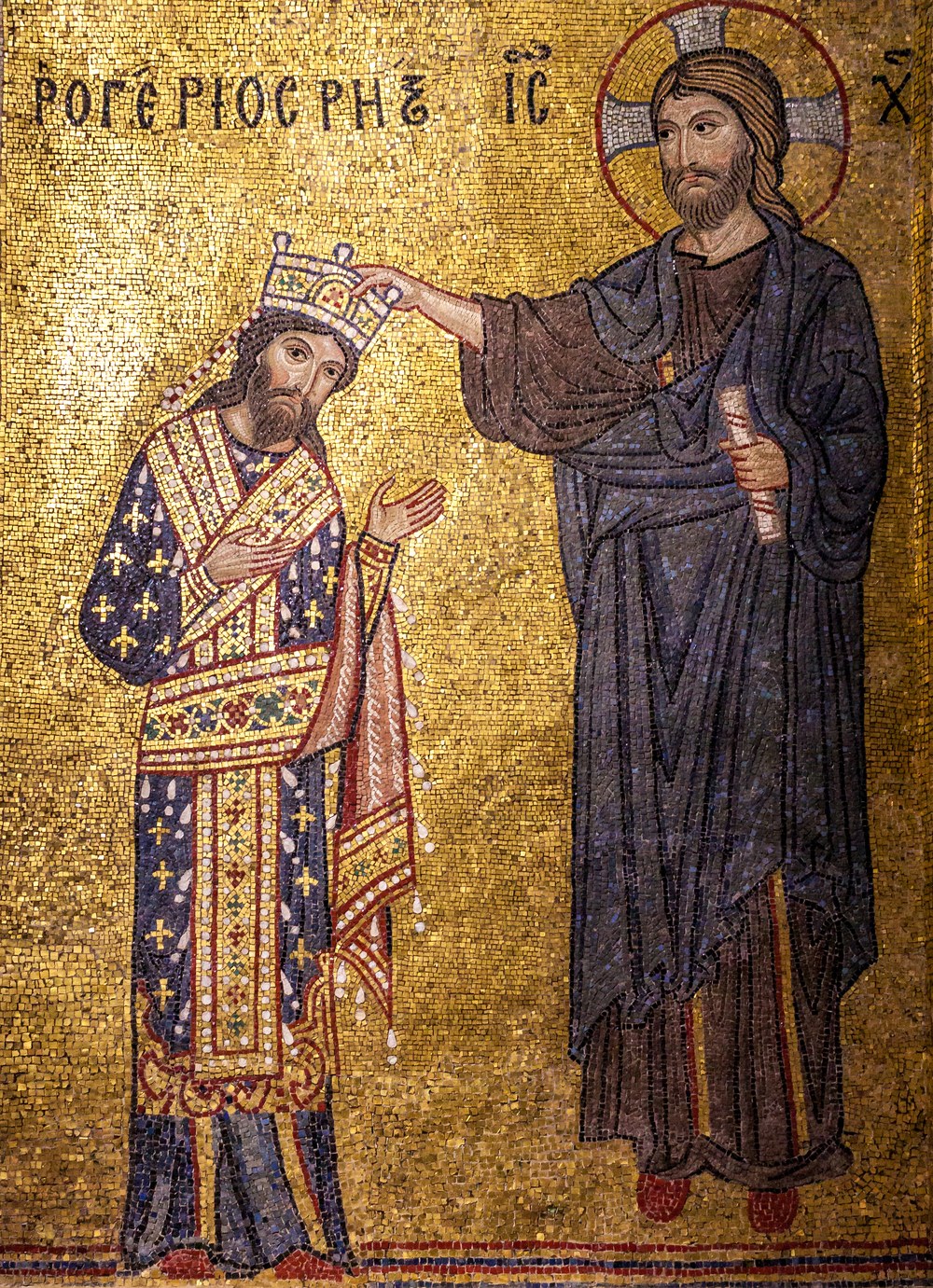
Roger II crowned by Christ — 12th-century mosaic from the Martorana, Palermo. The Greek inscription reads "Roger, King of Sicily."
Roger's ambitions for the Cathedral were vast. He intended it as the royal mausoleum of the Hauteville dynasty — a Norman Westminster Abbey. He had two magnificent porphyry sarcophagi installed in the presbytery for himself and his heir. He died in 1154 and was buried at Palermo instead, and the sarcophagi eventually ended up there too. The dynastic pantheon never materialized. But the building Roger began endures as one of the finest medieval structures in the world.
The Cathedral at a Glance
- Founded 1131 by Roger II, King of Sicily
- UNESCO World Heritage Site since 2015
- Christ Pantocrator mosaic completed 1148 — among the oldest and finest Byzantine mosaics outside Constantinople
- The nave columns are almost certainly repurposed from a pre-existing classical structure
- Two Roman porphyry sarcophagi still visible in the presbytery — Roger II's original funerary provision
- Construction of the facade towers continued across multiple centuries
The Christ Pantocrator
No visitor to Cefalù leaves the Cathedral unchanged. The Christ Pantocrator — Christ the All-Powerful — gazes down from the golden vault of the apse in a mosaic completed in 1148, just seventeen years after the Cathedral's foundation. It is one of the most complete and technically brilliant Byzantine mosaic cycles in existence.
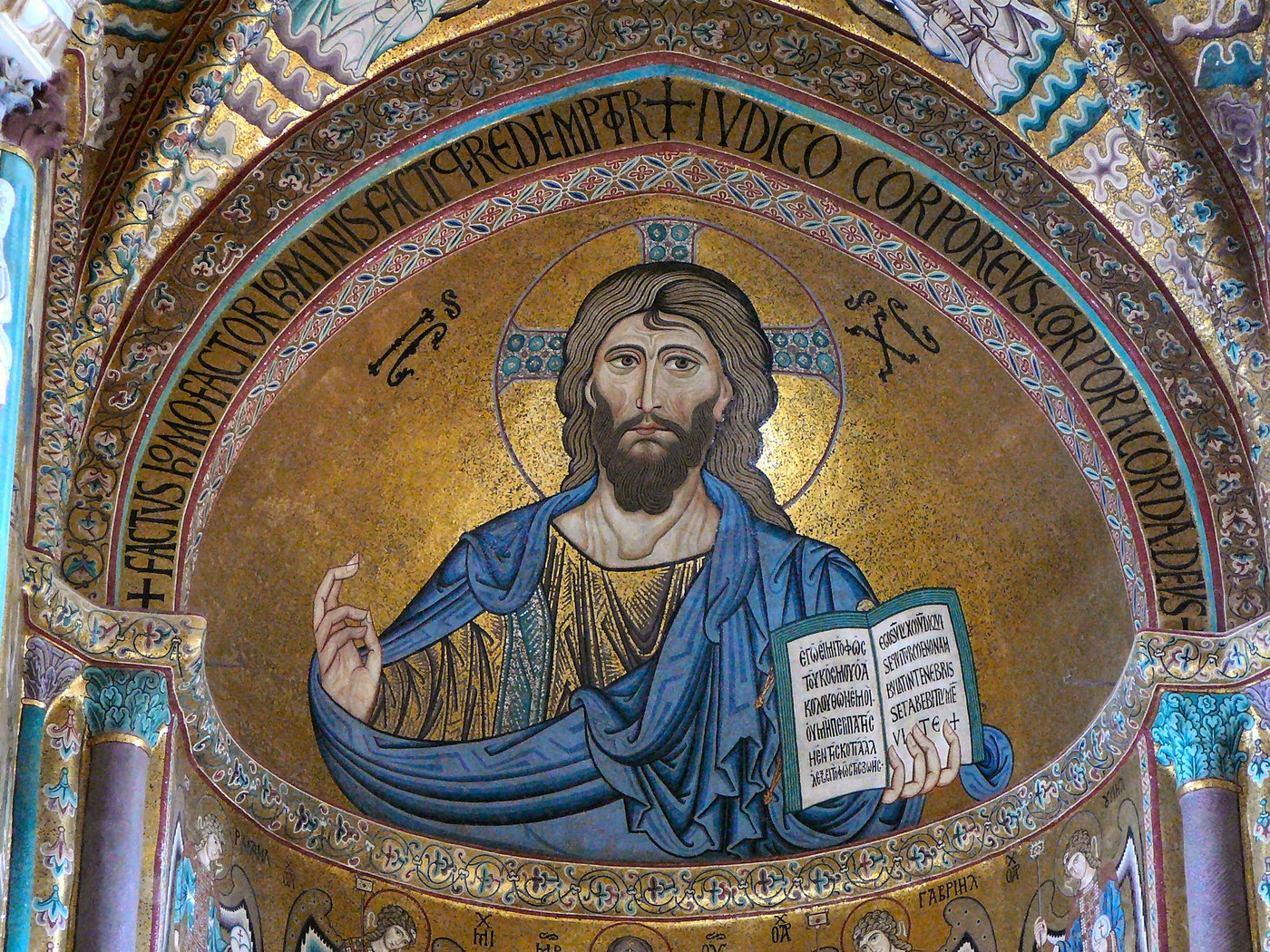
The Christ Pantocrator, 1148. One hand raised in blessing, the other holds a Gospel open in both Greek and Latin — a statement of the Norman kingdom's bicultural ambition.
The image is arresting. Christ is depicted full-face, one hand raised in blessing, the other holding an open Gospel inscribed in both Greek and Latin — a deliberate statement of the Norman state's bilingual, bicultural identity. The deep golden background, the intensity of the gaze, the sheer scale of the work: it demands contemplation. Below the Pantocrator, the Virgin in the position of intercession and flanking archangels and apostles complete the theological programme. The scheme was intended to cover the entire interior but was never fully executed. What was completed is extraordinary enough.
Spanish Rule, the Bourbons, and Unification
In 1282, the bloody popular uprising known as the Sicilian Vespers drove the French Angevins from the island and delivered Sicily to the Crown of Aragon. Cefalù entered a long period of Spanish rule that would last, with brief interruptions, until 1713. The town's character solidified during these centuries: the fishing fleet remained active, the Cathedral chapter wielded considerable local power, and the narrow streets accumulated the layered facades and baroque ornament that survive today.
The Spanish era left its mark on the physical fabric of the town. Many of the ornate stone doorways you pass on Via Vanni and the surrounding streets — some crowned with carved heraldry, others with classical pilasters — date from the 16th and 17th centuries, when Cefalù's merchant families built with the quiet prosperity that came from trade and the sea.
The Bourbon dynasty took control of Sicily in 1734 and ruled until 1860, when Giuseppe Garibaldi's Thousand landed at Marsala and swept up through the island in one of the most dramatic campaigns of the Risorgimento. Cefalù passed smoothly into the unified Kingdom of Italy in 1861. Unification brought new roads and railways — the coastal line that passes through Cefalù and connects it to Palermo opened in 1886 — but also the economic disruption and emigration that characterized southern Italy's 19th century.
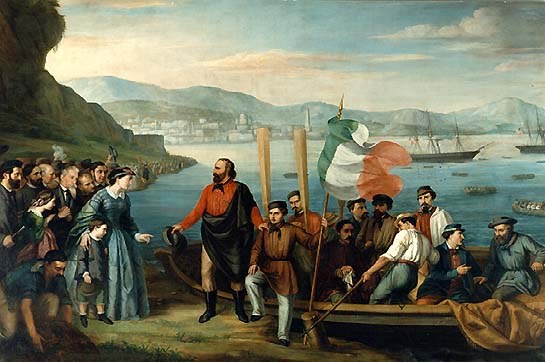
Partenza da Quarto — Garibaldi in his red shirt, departing with the Thousand on May 5, 1860. Sicily was their first objective.
The 'Ntinna a Mari: Cefalù's Living Festival
Among all the traditions that have survived in Cefalù across the centuries, the 'Ntinna a Mari is perhaps the most vividly alive. Every August — tied to the feast of the Assumption and the long summer of Ferragosto — a long pole is extended horizontally from the ancient sea wall of the harbor, greased from end to end and suspended over the water. Young men of the town attempt to walk its length to claim a flag planted at the far end. They fall — inevitably, repeatedly, to the delight of the crowd — into the sea below. Eventually, someone makes it.
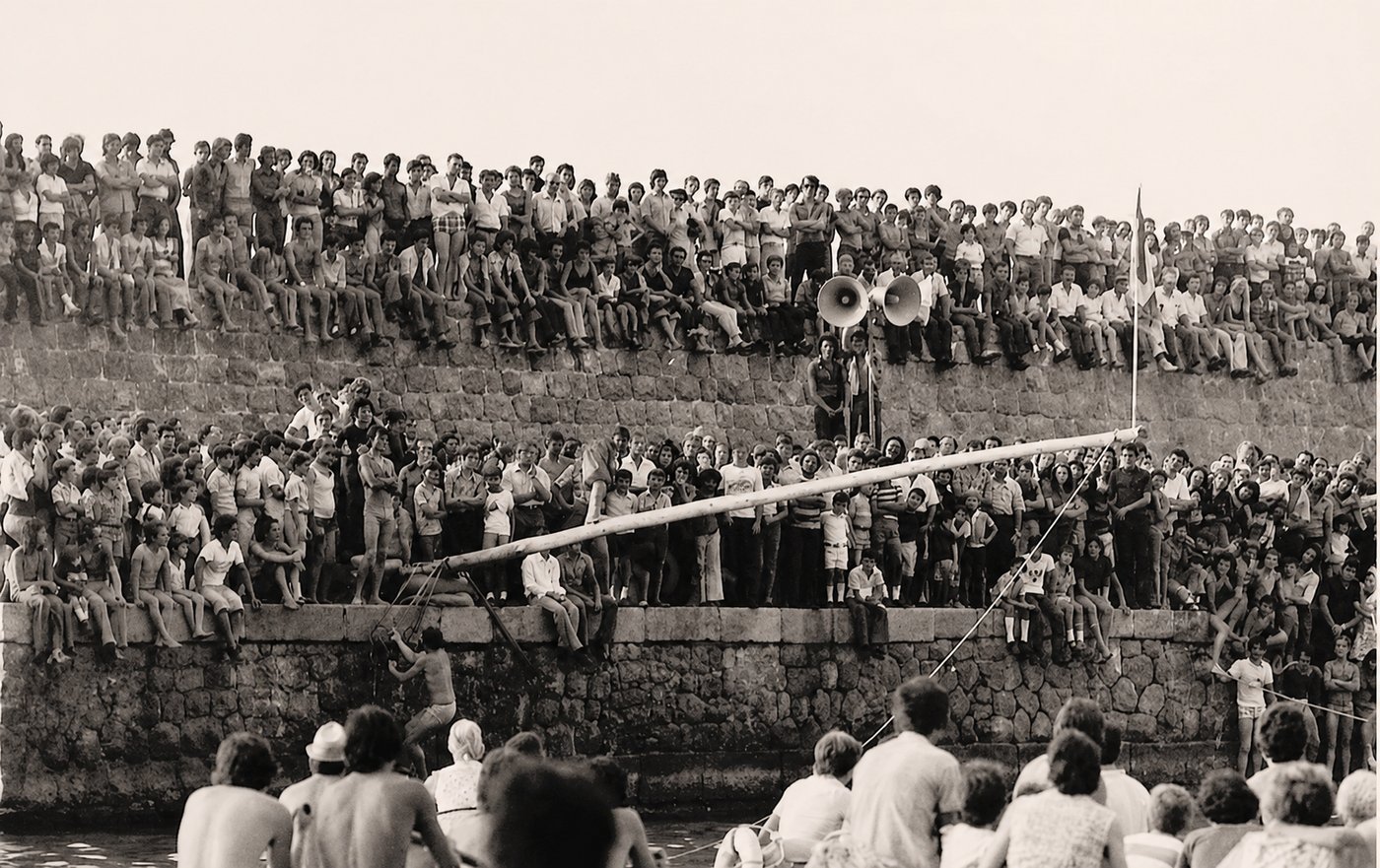
The 'Ntinna a Mari — an ancient tradition still drawing the entire town to the harbor wall each August.
The crowd that assembles for the 'Ntinna a Mari is the whole of Cefalù. Every ledge of the ancient harbor wall is packed. Families perch on every available surface. The commentary from the loudspeaker echoes across the water. The patience required — watching contestant after contestant slide into the sea — is rewarded with the particular joy of a town celebrating itself, its summer, and a tradition it has maintained for centuries.
The tradition's origins are tied to the fishing community. The "ntinna" was originally the bowsprit of a fishing vessel — the pole that projects forward from the bow. Using it as a test of balance and agility over water made natural sense in a town where men's lives depended on their sure-footedness on boats. The festival migrated from the boats to the harbor wall at some point in the town's history, and has remained there ever since.
The Second World War
The summer of 1943 brought the war to Cefalù's doorstep. On the night of July 9–10, Operation Husky — the Allied invasion of Sicily — launched the largest amphibious operation in history to that point. American forces under General Patton landed in southwestern Sicily; British and Commonwealth forces under General Montgomery in the southeast. Within days, two fronts were advancing through the island, converging on Messina and the straits that separated Sicily from the Italian mainland.
Cefalù lay on the northern coastal route — the road that would become the axis of the American advance toward Palermo and then east along the Tyrrhenian coast. The Germans used the coastal highway and the railway as lines of supply and retreat, conducting a fighting withdrawal of considerable tactical skill. Allied aircraft bombed strategic targets along the coast, and the civilian population endured weeks of uncertainty, food shortages, and the sounds of war moving progressively closer from the west.
When American forces arrived in Cefalù in late July 1943, the town passed into Allied hands with relatively limited damage — the Germans had begun their organized evacuation toward Messina. The Allied Military Government of Occupied Territory (AMGOT) administered Sicily in the immediate aftermath of liberation, working to restore basic services and civil order in a population exhausted by years of war and the autarchic failures of the Fascist regime.
For the Cefaludesi, liberation brought relief but also hardship. Food remained scarce in the immediate post-war years. Many families had lost sons to the conflict. And the structural poverty of southern Italy — which the war had only worsened — would drive a significant wave of emigration in the 1950s and 1960s, as young people left for the factories of Turin and Milan, for Germany, and for the Americas.
Contemporary Cefalù: Tourism, Heritage, and the Living Town
The post-war decades transformed Cefalù slowly, then rapidly. The reconstruction of Italy's economy brought new prosperity and, eventually, new visitors. The beach — long known to locals as one of the finest on the northern Sicilian coast — began attracting tourists in significant numbers through the 1960s and 1970s. Hotels appeared along the lungomare. The summer population swelled. The town adapted.
In 1988, Cefalù entered the consciousness of world cinema. Giuseppe Tornatore's Cinema Paradiso — the story of a boy's love of film in a small Sicilian town — was partly filmed in Cefalù's streets and squares, and won the Academy Award for Best Foreign Language Film. The film introduced the town to an international audience and became part of the local identity: the Teatro Cicero, where the opening scenes were shot, stands in the old town today, a quiet piece of cinematic history that most visitors walk past without knowing.
In 2015, Cefalù's Cathedral was inscribed on the UNESCO World Heritage List as part of the serial site "Arab-Norman Palermo and the Cathedral Churches of Cefalù and Monreale" — formal recognition of what residents had always known: that the building at the heart of their town is one of the defining achievements of medieval European civilization.
Today the town navigates the familiar tension of any beautiful place: between preservation and development, between the demands of summer tourism and the rhythms of a working community. The fishing boats still go out most mornings. The passeggiata still fills the Lungomare each evening. The 'Ntinna a Mari still draws the whole town to the harbor wall in August. And the Christ Pantocrator still gazes down from the apse of the Cathedral, unchanged since 1148, over a town that has absorbed empires and emerged, each time, as itself.
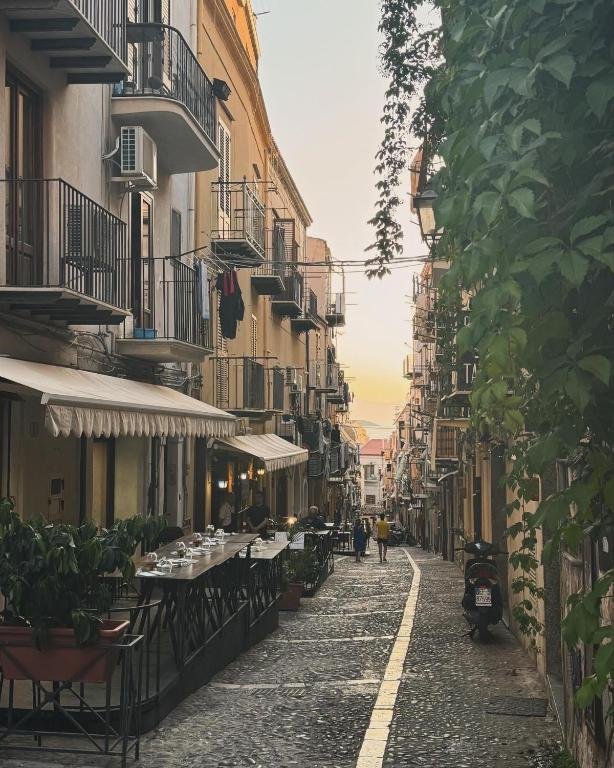
Via Vanni at sunset — where Amuni a Mari sits.
Today the town navigates the familiar tension of any beautiful place: between preservation and development, between the demands of summer tourism and the rhythms of a working community. The fishing boats still go out most mornings. The passeggiata still fills the Lungomare each evening. The 'Ntinna a Mari still draws the whole town to the harbor wall in August. And the Christ Pantocrator still gazes down from the apse of the Cathedral, unchanged since 1148, over a town that has absorbed empires and emerged, each time, as itself.